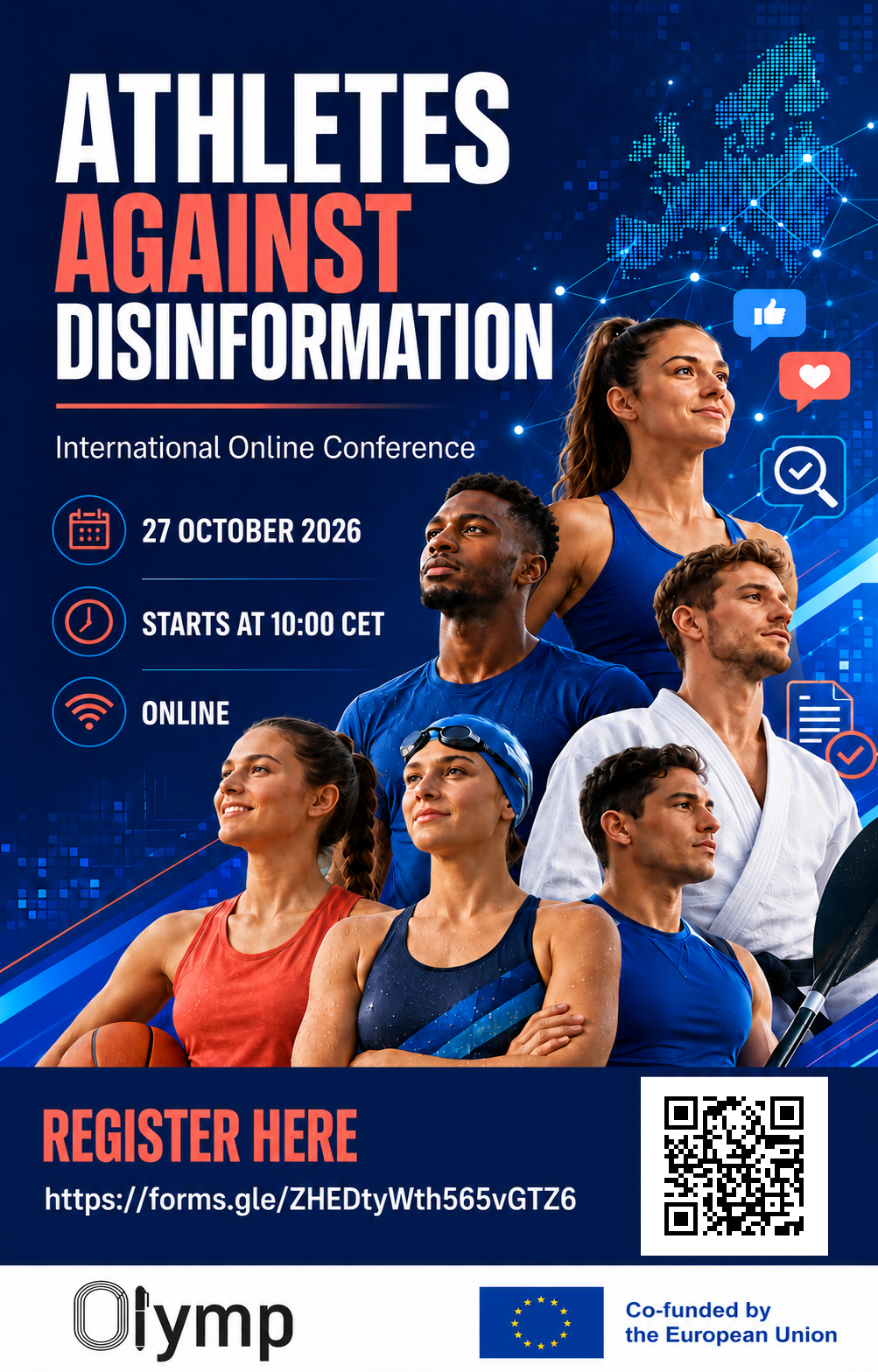
On 27 October 2026, the international online conference "Athletes Against Disinformation" took place. It was hosted by the Romanian Olympic and Sports Committee (COSR) as part of the European project OLYMP — "Fostering Media Literacy and Athlete Empowerment through OLYMPic Values", co-funded by the European Union. The National Olympic Committee of Ukraine invited all-Ukrainian Olympic sports federations to take part.
The speakers were Katerina Cuenova, Alina Cherghisan and Miha Marinsek.
The project aims to develop athletes' critical thinking, fact-checking skills and resilience to disinformation. The consortium brings together the Bulgarian Olympic Committee (coordinator), the Romanian Olympic and Sports Committee, the University of Maribor Library (Slovenia), the Lithuanian Olympians Association and NYSA Sweden.
The Romanian partners shared their own experience: more than 30 workshops with athletes and media literacy activities during Champion After Week. In September 2026 they also held a film screening with discussion, a public book reading and the OLYMP National Conference.
Participants discussed the scale of the problem. During the Paris 2024 Olympic Games, the IOC verified and reported more than 10,200 abusive posts for removal. At Tokyo 2020, 87% of recorded discriminatory abuse targeted female athletes, and 25% of abusive messages were unfounded doping accusations.
The session also drew a clear line between misinformation (false content shared without intent to deceive), disinformation (deliberate falsehoods spread to cause harm) and cyberbullying (targeted harassment of a person) — each calls for a different response.
- a manipulated clip released before a major competition;
- sexualised rumours targeting a female athlete after a performance error;
- false health information;
- an old post taken out of context.
For each scenario they mapped the harm that could occur in the first 24 hours, the first steps for the athlete and the organisation, and which responses could unintentionally amplify the harm.
- reverse image search;
- InVID/WeVerify;
- fact-checking resources;
- platform reporting tools.
The conference closed with an athlete campaign lab and a vote on long-term solutions in four areas: formal education, informal sport learning, sport organisations, and platforms and public policy.
- appointing a named safeguarding focal point for online abuse;
- creating a private reporting channel for athletes facing online abuse;
- having a one-page rapid-response protocol for the first 24 hours;
- building media literacy into athlete and coach training.
The conference outputs will feed into the OLYMP project's policy recommendations, to be presented at a high-level conference in Brussels.
👏 Thank you to the organisers and speakers for a valuable discussion! We encourage athletes, coaches and fans to check information before sharing it.
Keep the ball in play! 🇺🇦 Glory to Ukraine!